


If you’ve ever caught yourself hunched over your phone, scrolling through social media or answering texts, you’re not alone. Here in Winter Garden, FL, Dr. Toro at Vertebre Chiropractic Studio sees patients every week who are dealing with neck pain, headaches, and stiffness directly related to their smartphone habits. What many people don’t realize is that this seemingly harmless habit is creating a widespread condition that chiropractors and healthcare providers are calling “text neck.” The posture you adopt while looking down at your device isn’t just uncomfortable in the moment—it’s creating lasting changes to your spine and musculoskeletal system. This article will help you understand what text neck really is, why it matters for your long-term health, and what you can do about it before minor discomfort becomes chronic pain.
What is text neck? Text neck is a repetitive strain injury caused by prolonged forward head posture while looking down at phones, tablets, or other handheld devices. This position places excessive stress on the cervical spine, surrounding muscles, and supportive tissues, leading to pain, stiffness, and potentially long-term spinal changes.
Table of Contents
- The Biomechanics of Forward Head Posture
- Common Causes and Risk Factors
- Signs and Symptoms of Text Neck
- Long-Term Effects on Your Spine
- How Chiropractic Care Can Help
- Practical Tips to Prevent Text Neck
- When to See a Chiropractor
- Posture Comparison Table
- Myths vs. Facts About Text Neck
- Final Thoughts
The Biomechanics of Forward Head Posture
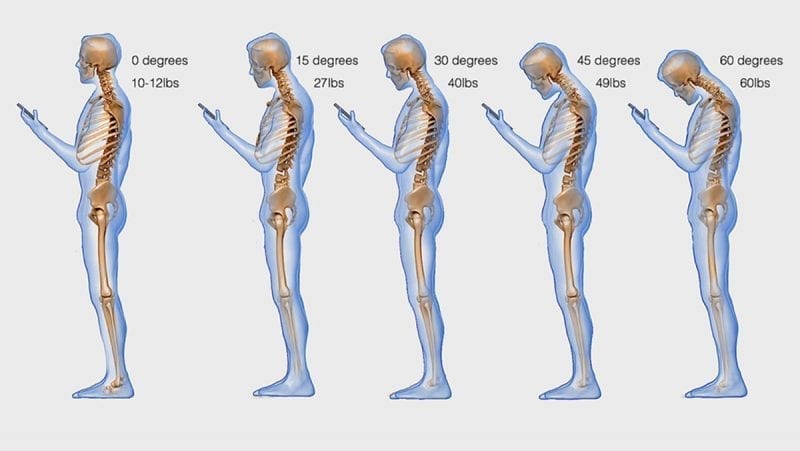
Your head weighs approximately 10 to 12 pounds when your neck is in a neutral position—essentially balanced directly over your shoulders. This is the position your cervical spine was designed to support. When you look down at your phone, tablet, or laptop, you shift your head forward and downward, dramatically increasing the effective weight your neck must support. Research indicates that for every inch your head moves forward from neutral alignment, the perceived weight on your cervical spine increases by roughly 10 pounds.
At a 15-degree forward tilt, your neck is supporting about 27 pounds. At 30 degrees, that jumps to 40 pounds. When you’re deeply engrossed in your device at a 60-degree angle—a common texting position—your neck is straining under approximately 60 pounds of pressure. Imagine carrying a heavy child on your shoulders for hours each day. That’s essentially what your neck muscles and spinal structures are doing when you maintain forward head posture.
The cervical spine consists of seven vertebrae designed to maintain a gentle forward curve called the cervical lordosis. This natural curve acts as a shock absorber and helps distribute forces efficiently. Forward head posture gradually flattens or even reverses this curve, compromising its ability to handle normal daily stresses. The muscles at the back of your neck—particularly the upper trapezius, levator scapulae, and suboccipital muscles—must work overtime to prevent your head from dropping further forward. Meanwhile, the muscles at the front of your neck become weakened and lengthened.
This muscular imbalance creates a cycle of dysfunction. Overworked posterior neck muscles develop painful trigger points and tension. Weakened anterior muscles fail to provide adequate support. The facet joints between vertebrae experience abnormal compression. Over time, this pattern can lead to degenerative changes, disc problems, and chronic pain syndromes that become increasingly difficult to reverse.
Common Causes and Risk Factors
While smartphone use is the most recognized cause of text neck, it’s far from the only culprit. At Vertebre Chiropractic Studio, we see patients whose forward head posture stems from multiple sources throughout their daily routines. Understanding these various contributors helps you identify where changes might have the biggest impact on your spinal health.
Prolonged smartphone use tops the list. The average American spends between three and five hours daily on their phone, often in multiple sessions throughout the day. Teenagers and young adults may exceed six or seven hours. When you multiply those hours by 365 days per year, you’re looking at thousands of hours in a compromised postural position. Your body simply wasn’t designed for this level of repetitive strain.
Tablet and e-reader use creates similar problems, often worse because these devices are typically held lower and used for extended reading sessions. Laptop work on your couch or bed without proper support forces your neck into sustained flexion. Even desktop computer setups can contribute if your monitor sits too low, requiring you to look downward rather than straight ahead.
Your occupation matters significantly. Office workers, students, writers, programmers, and anyone whose job involves extended screen time face elevated risk. Healthcare professionals who frequently look down during procedures, hairstylists, and dental hygienists also commonly develop text neck symptoms. Here in Winter Garden, we work with many professionals whose careers demand sustained forward head positions.
Gaming represents another major risk factor, particularly for younger populations. Whether it’s console gaming, handheld gaming devices, or mobile gaming, the forward head posture remains consistent. Students carrying heavy backpacks, particularly when worn on one shoulder or carried too low, develop compensatory forward head posture to balance the load.
Previous neck injuries create vulnerability. If you’ve experienced whiplash, sports injuries, or other neck trauma, your cervical spine may already have compromised stability or altered biomechanics. Adding the stress of text neck accelerates degenerative changes and increases pain susceptibility. Sedentary lifestyles compound the problem—weak core muscles provide inadequate spinal support, and tight chest muscles pull the shoulders forward, encouraging head-forward positioning.

Signs and Symptoms of Text Neck
Text neck rarely announces itself with sudden, dramatic pain. Instead, it typically develops gradually, with symptoms that many people initially dismiss as minor annoyances. Recognizing these early warning signs is crucial for preventing the condition from progressing to chronic pain and structural changes.
Neck pain and stiffness are the most common complaints. You might notice a dull, nagging ache at the base of your skull or between your shoulder blades. The discomfort often worsens as the day progresses or after extended device use. Morning stiffness upon waking suggests your neck isn’t recovering adequately during sleep, possibly because your daytime posture has created such significant muscle tension that it persists overnight.
Headaches represent another hallmark symptom. These typically begin at the base of the skull and radiate forward toward the temples or behind the eyes. Called cervicogenic headaches, they originate from neck dysfunction rather than primary headache disorders. The suboccipital muscles become so tight and irritated that they refer pain into the head. Many patients at Vertebre Chiropractic Studio initially seek care for “chronic headaches” without realizing their neck posture is the underlying cause.
Shoulder pain and upper back tension frequently accompany text neck. The rounded shoulder position that goes hand-in-hand with forward head posture creates strain through the upper trapezius muscles and between the shoulder blades. You might feel like you’re carrying tension in your shoulders or experience painful knots that won’t release no matter how much you stretch or massage them.
Reduced range of motion becomes noticeable over time. Turning your head to check blind spots while driving might feel restricted or uncomfortable. Looking up at the sky or tilting your head backward may produce pain or tightness. Some people describe a sensation of their neck “catching” or “locking up” during certain movements.
Numbness or tingling in the arms and hands can develop as text neck progresses. Forward head posture can compress nerves exiting the cervical spine or passing through the shoulder region. You might experience pins-and-needles sensations, weakness in grip strength, or the feeling that your arms “fall asleep” more easily than they used to.
Fatigue is an often-overlooked symptom. When your postural muscles work overtime all day to support poor alignment, your body expends tremendous energy. This muscular fatigue can contribute to overall feelings of exhaustion and decreased stamina. Some patients also report difficulty concentrating, which makes sense when you consider that chronic pain and muscle tension are mentally draining.
Long-Term Effects on Your Spine
The real concern with text neck isn’t just today’s discomfort—it’s what happens to your spine over months and years of sustained poor posture. Your body is remarkably adaptive, which works in your favor when you’re building healthy habits but against you when you’re reinforcing harmful patterns. The spine will remodel itself to accommodate the stresses you consistently place on it.
Loss of cervical lordosis is one of the first structural changes. That natural forward curve in your neck gradually flattens, creating what’s sometimes called “military neck” or straight cervical spine. In more severe cases, the curve actually reverses, creating a backward C-shape instead of the healthy forward curve. This altered curvature compromises shock absorption and increases stress on the intervertebral discs and facet joints.
Premature degenerative disc disease can develop. The discs between your vertebrae are designed to handle compressive forces when your spine is properly aligned. Sustained abnormal loading accelerates disc degeneration. The outer disc layers may develop small tears, the disc height decreases, and the cushioning capacity diminishes. While some disc degeneration is a normal part of aging, text neck accelerates this process, potentially leading to problems in your 30s and 40s that might otherwise not appear until your 60s or 70s.
Cervical osteoarthritis represents another long-term consequence. The facet joints—the small joints on either side of each vertebra—experience abnormal wear patterns from sustained forward head posture. This can lead to bone spur formation, joint inflammation, and progressive stiffness. Once established, these arthritic changes are permanent, though their symptoms can often be managed effectively.
Muscle imbalances become deeply ingrained. The weakened deep neck flexors lose their ability to stabilize your cervical spine properly. The chronically tight posterior muscles develop shortened resting lengths and lose flexibility. This muscular dysfunction makes it progressively harder to maintain good posture, even when you’re consciously trying, creating a self-perpetuating cycle.
Postural syndrome can extend beyond the neck. Forward head posture typically accompanies rounded shoulders, increased thoracic kyphosis (upper back rounding), and compensatory changes in the lower back. This altered spinal alignment affects your entire kinetic chain, potentially contributing to problems in areas seemingly unrelated to your phone use—including lower back pain, hip dysfunction, and even knee problems.
The nervous system may be compromised over time. Chronic compression or irritation of cervical nerves can lead to persistent neurological symptoms. Some research also suggests that altered cervical alignment may affect cerebrospinal fluid flow and proprioception—your body’s sense of where it is in space—though more study is needed to fully understand these connections.
How Chiropractic Care Can Help
Chiropractic care offers a conservative, non-invasive approach to addressing text neck that focuses on restoring proper spinal alignment, improving joint function, and retraining postural patterns. At Vertebre Chiropractic Studio in Winter Garden, Dr. Toro takes a comprehensive approach that addresses not just your symptoms but the underlying biomechanical dysfunction creating them.
The first step involves a thorough assessment. This includes postural analysis to identify specific alignment issues, range of motion testing to evaluate joint restrictions, and palpation to locate areas of muscle tension and spinal dysfunction. Many chiropractors also use specialized imaging or measurement tools to document the severity of forward head posture and track improvements over time. Understanding your unique presentation allows for truly individualized care rather than a one-size-fits-all approach.
Chiropractic adjustments form the cornerstone of treatment. These precise, controlled movements restore proper motion to restricted spinal joints, particularly in the cervical and upper thoracic regions. When vertebrae aren’t moving properly, the surrounding muscles compensate, creating additional tension and pain. Adjustments help break this cycle by normalizing joint mechanics. Many patients report immediate relief in range of motion and reduction in muscle tension following adjustments.
Soft tissue therapy addresses the muscular component of text neck. Techniques may include trigger point therapy to release painful muscle knots, myofascial release to improve tissue mobility, or instrument-assisted soft tissue mobilization. The chronically tight posterior neck muscles need direct attention to release tension that adjustments alone may not fully resolve. Similarly, addressing tightness in the chest muscles helps reduce the anterior pull that encourages rounded shoulders.
Postural rehabilitation exercises are essential for lasting results. Your chiropractor will teach you specific exercises to strengthen weak deep neck flexors, stretch tight muscles, and retrain proper posture. These might include chin tucks, scapular retraction exercises, and thoracic extension stretches. The goal is to build new, healthier movement patterns that you maintain even when you’re not thinking about your posture.
Ergonomic guidance helps you modify the activities contributing to text neck. This includes recommendations for device positioning, workspace setup, and movement breaks. Dr. Toro often works with patients to identify specific situations in their daily routines where small changes can significantly reduce cervical stress.
At Vertebre Chiropractic Studio, care is individualized based on your specific condition, lifestyle, and goals. Some patients with acute text neck symptoms experience significant improvement within a few weeks of consistent care. Others with more chronic conditions or structural changes may benefit from ongoing supportive care to manage symptoms and prevent progression. The key is addressing the problem before it becomes deeply established in your spinal structure.
Practical Tips to Prevent Text Neck
Prevention is always easier than correction. Even if you’re already experiencing text neck symptoms, implementing these strategies will support your recovery and prevent further deterioration. Small, consistent changes in how you use technology and position your body throughout the day can have remarkable cumulative effects.
Raise your devices to eye level. This single change may be the most impactful thing you can do. Instead of looking down at your phone, hold it higher so you’re looking straight ahead. Your shoulders and arms will tire before long, which serves as a natural reminder to take a break—a built-in benefit. For tablets, use a stand or case that props the device at an angle closer to eye level. When working on a laptop, invest in a laptop stand and external keyboard so your screen sits at proper height.
Take frequent breaks from device use. The 20-20-20 rule works well: every 20 minutes, take 20 seconds to look at something 20 feet away. This gives your neck muscles a chance to reset and prevents the sustained static posture that causes the most damage. Set reminders on your phone if needed—the irony of using your phone to remind yourself to put down your phone isn’t lost on us, but if it works, use it.
Practice chin tucks throughout the day. This simple exercise helps retrain your deep neck flexors and counteracts forward head posture. Gently draw your chin straight back, creating a “double chin,” while keeping your eyes level. Hold for five seconds, then relax. Repeat 10 times. Do this several times daily, especially after extended device use. Think of it as a reset button for your neck posture.
Strengthen your upper back and rear shoulder muscles. Exercises like scapular squeezes, rows, and reverse flys help counteract the forward-rounded shoulder position that accompanies text neck. Stronger upper back muscles make it easier to maintain upright posture throughout the day. You don’t need a gym membership—resistance bands or even bodyweight exercises work well.
Stretch your chest and anterior shoulder muscles. Doorway stretches are particularly effective. Place your forearm against a door frame with your elbow at 90 degrees, then gently turn your body away from that arm until you feel a stretch across your chest. Hold for 30 seconds on each side. Tight chest muscles pull your shoulders forward, so regular stretching helps maintain better alignment.
Optimize your sleeping position. Your pillow height and sleeping posture matter more than you might think. Your pillow should support your neck’s natural curve without pushing your head too far forward or letting it drop too far back. Side sleepers need a thicker pillow than back sleepers. Avoid stomach sleeping, which forces your neck into rotation for hours at a time.
Be mindful of your overall posture throughout the day. Notice how you sit at your desk, stand while waiting in line, or position yourself on the couch. When sitting, keep your feet flat on the floor, your back supported, and your shoulders relaxed. Imagine a string pulling the crown of your head toward the ceiling, lengthening your spine. Check in with your posture multiple times daily until good alignment becomes more habitual.
Consider your car’s headrest position. Many people drive with their head positioned forward of their headrest. Adjust your headrest so it supports the back of your head in a neutral position. This not only helps your posture during driving but also provides crucial protection in case of rear-end collisions.
When to See a Chiropractor
Many people wonder if their neck discomfort warrants professional attention or if it’s something they should simply “push through.” Understanding when to seek chiropractic care can prevent minor problems from becoming major ones and help you get relief sooner rather than later.
If you’re experiencing persistent neck pain or stiffness lasting more than a week or two, it’s time to schedule an evaluation. While occasional neck discomfort after a long day isn’t necessarily cause for alarm, symptoms that don’t resolve with rest and simple self-care measures deserve professional attention. The sooner you address developing text neck, the easier it is to correct.
Frequent headaches, particularly those starting at the base of your skull, warrant evaluation. If you’re taking over-the-counter pain medication multiple times per week for neck pain or headaches, you’re treating symptoms rather than addressing the underlying cause. Chiropractic care can often reduce or eliminate the need for pain medication by correcting the biomechanical dysfunction creating your symptoms.
Any neurological symptoms—numbness, tingling, weakness, or “electric” sensations traveling down your arms—should be evaluated promptly. While these symptoms can result from text neck-related nerve compression, they can also indicate more serious conditions that require immediate attention. A thorough examination can determine the source and appropriate treatment approach.
Difficulty with daily activities signals it’s time to seek help. If neck pain or stiffness is interfering with your work, exercise routine, or normal activities like driving or sleeping, professional care can help restore function and quality of life. You shouldn’t have to modify your entire lifestyle around neck pain.
If you’re noticing progressive worsening despite your own efforts to improve posture and take breaks, professional guidance is valuable. Sometimes text neck has progressed to the point where self-care alone isn’t sufficient. A chiropractor can provide targeted treatment and rehabilitation strategies that accelerate recovery.
Prevention is also a valid reason to seek chiropractic care. If you work in a profession with high text neck risk or you’re concerned about the amount of time you spend on devices, a baseline evaluation and postural training can help prevent problems before they start. Many patients at Vertebre Chiropractic Studio in Winter Garden come in proactively, wanting to optimize their spinal health rather than waiting for pain to develop.
Red flags that warrant immediate medical evaluation include severe pain following trauma, neck pain accompanied by fever, progressive weakness, loss of bowel or bladder control, or neck pain with unexplained weight loss. While these symptoms are unlikely to be related to text neck alone, they require prompt medical attention to rule out serious conditions.
Posture Comparison Table
| Postural Element | Healthy Neutral Position | Text Neck Position | Impact on Spine |
|---|---|---|---|
| Head Position | Centered over shoulders, ears aligned with shoulders | Forward and downward, ears 2-4 inches ahead of shoulders | Increases effective head weight from 12 lbs to 60+ lbs |
| Cervical Curve | Gentle forward (lordotic) curve | Flattened or reversed curve | Reduces shock absorption, increases disc stress |
| Shoulder Position | Back and down, shoulder blades resting against ribcage | Rounded forward, elevated toward ears | Strains upper trapezius, weakens shoulder blade stabilizers |
| Upper Back | Slight natural curve, chest open | Exaggerated rounding (hyperkyphosis) | Restricts breathing, contributes to forward head posture |
| Muscle Activation | Balanced front-to-back muscle engagement | Overactive posterior neck, weak deep neck flexors | Creates painful trigger points, chronic muscle fatigue |
| Joint Loading | Even distribution across cervical facet joints | Excessive compression on posterior joints | Accelerates degenerative changes and arthritis |
Myths vs. Facts About Text Neck
Myth: Text neck only affects people who use their phones excessively
Fact: While heavy smartphone use is a major contributor, text neck can develop from any sustained forward head posture, including reading, laptop use, tablet viewing, or certain occupational demands. Even moderate daily device use combined with poor ergonomics at work can create significant problems over time.
Myth: Young people don’t need to worry about text neck because their bodies are more resilient
Fact: Young people are actually at higher risk for developing text neck due to greater device use and longer lifetime exposure. Research indicates that postural habits established in adolescence and early adulthood set the stage for spinal health throughout life. Starting prevention strategies early is crucial rather than waiting until pain develops.
Myth: Once you have structural changes like lost cervical curve, there’s nothing you can do about it
Fact: While advanced degenerative changes are permanent, many people experience significant symptom improvement and functional restoration through chiropractic care, rehabilitation exercises, and posture modification. Some postural changes can partially reverse with consistent care, especially when addressed before they become severe. Even when structural changes persist, quality of life can improve substantially.
Myth: Taking breaks from your phone for a few minutes each hour is sufficient prevention
Fact: While breaks are helpful, prevention requires multiple strategies including proper device positioning, postural awareness, strengthening exercises, and ergonomic modifications. Simply taking breaks without addressing head and neck position during device use leaves you vulnerable to text neck development. The position you maintain while using devices matters as much as the duration.
Myth: Text neck symptoms will resolve on their own if you just ignore them
Fact: Text neck rarely improves without intervention because most people continue the habits that created the problem. Symptoms typically worsen over time as muscle imbalances deepen and structural changes progress. Early intervention prevents minor discomfort from becoming chronic pain and permanent spinal changes. Addressing text neck proactively yields better outcomes than waiting until symptoms become severe.
Final Thoughts
Text neck has become one of the most common musculoskeletal complaints in modern society, affecting people of all ages across Winter Garden and beyond. The good news is that with awareness, intentional habit changes, and appropriate care when needed, text neck is largely preventable and treatable. Your daily choices about how you position your body while using technology have profound effects on your spinal health, but small consistent changes can reverse years of poor postural habits.
At Vertebre Chiropractic Studio here in Winter Garden, FL, Dr. Toro is committed to helping patients understand the connection between their daily habits and their spinal health. Whether you’re already experiencing text neck symptoms or you want to prevent problems before they start, chiropractic care offers a safe, effective, non-invasive approach to optimizing your neck and spine function. Your cervical spine is designed to support you comfortably for a lifetime—giving it the attention and care it deserves today will pay dividends in pain-free function for years to come.
Remember that your phone and other devices are tools meant to enhance your life, not compromise your health. Finding the balance between staying connected and maintaining proper posture is possible with mindfulness and the right strategies. If you’re concerned about text neck or experiencing any of the symptoms discussed in this article, don’t hesitate to reach out for a consultation. Your neck will thank you.
Frequently Asked Questions
How long does it take to reverse text neck?
The timeline for improving text neck varies based on severity and how long the condition has been developing. Many people notice reduced pain and improved range of motion within 2-4 weeks of consistent chiropractic care and postural modifications. More significant structural improvements may take several months of dedicated rehabilitation, particularly if cervical curve changes have occurred.
Can children develop text neck?
Yes, children and adolescents are increasingly developing text neck as device use begins at younger ages. Their developing spines are particularly vulnerable to postural stress, and habits formed during childhood often persist into adulthood. Parents should monitor device use duration, encourage proper positioning, and ensure children take regular movement breaks.
Is text neck the same as forward head posture?
Text neck is a specific type of forward head posture caused primarily by looking down at handheld devices. Forward head posture is the broader term describing any positioning where the head sits anterior to the shoulders, which can result from various causes including poor workstation ergonomics, weak postural muscles, or previous injuries. Text neck has become a common cause of forward head posture in recent years.
Will a neck brace or posture corrector help with text neck?
Posture correctors can serve as helpful reminders and training tools when used temporarily and in conjunction with strengthening exercises. However, relying on them long-term can actually weaken postural muscles further. They’re best used as part of a comprehensive approach that includes active rehabilitation, ergonomic modifications, and chiropractic care rather than as a standalone solution.
Does text neck cause permanent damage?
Left unaddressed, text neck can lead to permanent structural changes including loss of cervical curve, degenerative disc disease, and osteoarthritis. However, when addressed early through postural correction, chiropractic care, and lifestyle modifications, many people prevent permanent damage and restore healthy spinal function. The key is intervention before changes become deeply established.
How often should I get adjusted for text neck?
Treatment frequency depends on your specific condition, symptom severity, and response to care. Initially, many patients benefit from adjustments 1-2 times per week for several weeks, with frequency gradually decreasing as symptoms improve and function is restored. Your chiropractor will develop an individualized care plan based on your unique presentation and goals.
TL;DR – Key Takeaways
- Text neck is a repetitive strain injury caused by sustained forward head posture while using devices, dramatically increasing the effective weight your neck must support—from 12 pounds in neutral position to 60+ pounds at typical texting angles.
- Common symptoms include neck pain and stiffness, headaches originating from the base of the skull, shoulder tension, reduced range of motion, and sometimes numbness or tingling in the arms.
- Long-term effects can include loss of the natural cervical curve, premature disc degeneration, arthritis, and deeply ingrained muscle imbalances that become progressively harder to correct without intervention.
- Chiropractic care addresses text neck through spinal adjustments, soft tissue therapy, postural rehabilitation exercises, and ergonomic guidance—a conservative approach that treats the underlying dysfunction rather than just masking symptoms.
- Prevention strategies include raising devices to eye level, taking frequent breaks, practicing chin tuck exercises, strengthening upper back muscles, and maintaining awareness of posture throughout daily activities.